

The process approach is a way of managing and improving business operations by viewing activities as a set of interconnected processes.
At its core is the Plan‑Do‑Check‑Act (PDCA) cycle, which supports continuous improvement by planning actions, carrying them out, checking the results, and making adjustments to improve outcomes.
Using a process approach helps us to standardise, communicate, and improve how our organisation carries out its day‑to‑day operations. It gives us a clear, structured way of working and provides a number of benefits, including:
Providing a Consistent and Standardised Service
By documenting all areas of our business, we can clearly communicate our policies, processes, and procedures to everyone who needs them. This means that every member of the organisation works from the same system, follows the same steps, and delivers a consistent service for customers.
When a process approach is fully embedded, it also empowers staff and helps to build trust with customers.
Example: Without a standard process, two team members dealing with customer queries might deliver very different levels of service. With a documented approach, they follow the same guidance, ensuring customers receive a uniform experience.
Driving Efficiencies
Documenting processes makes it easier to review how we work and identify where improvements can be made. This can reduce waste, cut costs, and help us to remain competitive and sustainable over the long term.
The more we refine and develop our systems, the more opportunities we find to work efficiently, make better use of resources, and support profitability and growth.
Example: A documented process may reveal a step that adds no value and can be removed — leading to faster and more efficient service delivery.
Providing a Holistic View of the Business
Mapping and linking processes gives a complete picture of how the organisation works. This makes it easier to spot any gaps, overlaps, or unclear areas of responsibility, and ensures processes work together smoothly.
Example: A high‑level process map might highlight how sales, order processing, fulfilment, and technical support interact, showing exactly where responsibilities pass from one team to another.
Ensuring Customer Satisfaction
The process approach directly supports customer satisfaction – not just through consistency, but also by making sure we ask important questions such as:
- Is the service good?
- Are customers happy with the service?
- How does it compare with competitors?
- Can we capture and act on feedback?
- Are we reviewing complaints and issues?
Example: Customer feedback may reveal areas for improvement that can be fed back into process design to improve the customer experience.
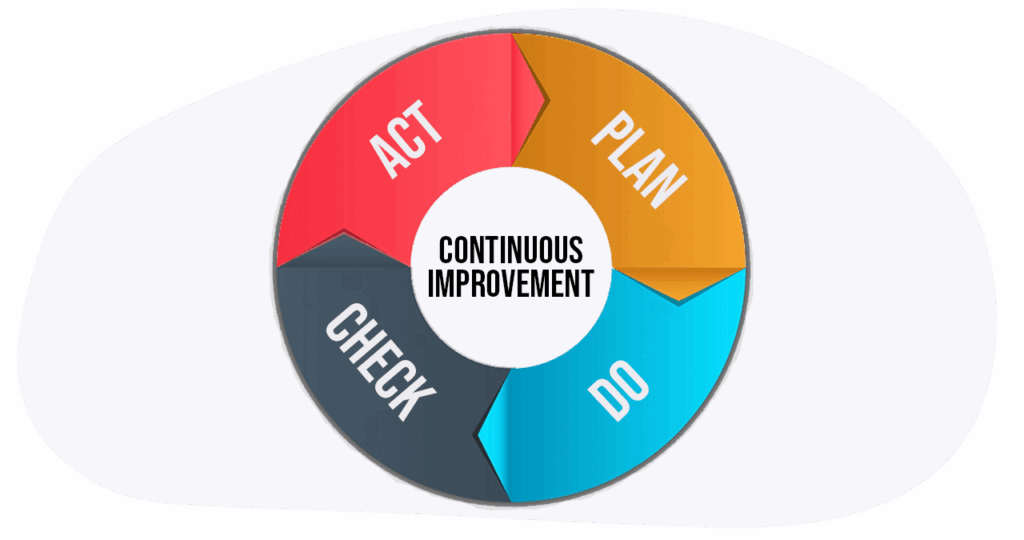
Driving Continuous Improvement
Change is constant – in the market, in customer needs, and in technology. The process approach, combined with regular reviews, helps us adapt effectively.
Continuous improvement means we keep checking that our processes work well, respond to new challenges, and take advantage of new opportunities.
Example: A periodic review might show that a manual task could be automated, improving both speed and quality of service.
In Summary
The process approach is not just a set of instructions – it’s a way of thinking. By documenting and standardising operations, organisations can deliver consistency, improve efficiency, and keep customers at the centre of everything they do.
At COO Academy, we see the process approach as a foundation for operational excellence – and a powerful tool for building resilient, successful organisations.
Want to Learn More?
The PDCA cycle sits at the heart of the ISO 9001 Quality Management Standard – making it an essential concept for any organisation aiming for operational excellence. If you want to understand exactly how PDCA works, how it links to ISO 9001, and how you can apply it to drive measurable improvements in your business, our ISO 9001:2015 Foundation eLearning course is the perfect place to start.
You’ll gain a clear, practical understanding of ISO 9001, discover how the process approach applies in real‑world scenarios, and learn how to make it work for your organisation from day one.